2026 Year-End Tax Moves for Retirees and Pre-Retirees
Year-End Tax Planning 2026: A Two-Year Guide for Retirees
The best year-end tax plan for 2026 is a two-year plan. Instead of asking how to cut this year’s bill, ask how to pay the least federal tax across 2026 and 2027 combined. Rates and deductions for the two years should look similar, which makes the comparison easier than usual.
For most retirees and pre-retirees, that comparison turns on one number: modified adjusted gross income (MAGI). It decides whether you keep the new senior deduction of up to $6,000 per person, whether your Medicare premiums rise in 2028, whether the 3.8% net investment income tax applies, and, for higher-income Maryland households, whether the state’s 2% capital gains surtax kicks in. A Roth conversion, a large capital gain, or an extra IRA withdrawal can cross one of these lines in a single transaction.
The moves themselves are familiar. Take required minimum distributions on time, give from your IRA if you’re charitable and 70½ or older, size any Roth conversion against the thresholds that matter to you, harvest losses carefully, decide whether to bunch deductions into one year, and confirm your withholding before the deadline passes. A good year-end plan does them in the right order, with a projection in hand, well before December 31.
Key takeaways
- Plan 2026 and 2027 as a pair. The goal is the lowest combined tax, and sometimes that means paying a little more this year.
- Know where your MAGI sits relative to the senior deduction phase-out, IRMAA tiers, the 3.8% investment income tax, and Maryland’s surtax before you add income.
- Qualified charitable distributions are usually the most tax-efficient way for IRA owners 70½ and older to give, especially if you take the standard deduction.
- Roth conversions must be completed by December 31, and the right amount depends on the thresholds you’re near, not just your tax bracket.
- Tax withheld from an IRA distribution counts as if paid evenly through the year, which makes a December distribution a clean fix for underpayment.
Why should you plan 2026 and 2027 together?
Because a deduction or a dollar of income usually lands in one year or the other, and the year it lands in changes what it’s worth. Most households come out ahead by pulling deductions into 2026 and pushing income into 2027. Others should do the reverse: someone with an unusually low-income 2026 (the first year of retirement, before Social Security or RMDs start) may want to recognize more income now while it’s taxed lightly. Since 2027’s rates and deductions should resemble 2026’s, the deciding factor is usually your own income in each year, not a change in the law.
| Your situation | Usually lean toward |
|---|---|
| 2027 income likely higher (RMDs begin, pension starts, Social Security claimed) | Recognize income in 2026: Roth conversions, gain harvesting |
| 2027 income likely lower (final working year is 2026, a one-time gain this year) | Pull deductions into 2026, defer income to 2027 |
| Itemized deductions just above the standard deduction | Bunch deductions into one year, take the standard deduction in the other |
| Close to an IRMAA tier or the senior deduction phase-out | Manage MAGI first, then decide on conversions and gains |
Which income thresholds matter most for retirees in 2026?
Several tax breaks and surcharges switch on or off at specific income levels, and each is measured a little differently. Some use MAGI, some use taxable income, and Maryland uses federal AGI. The table below shows the ones retirees bump into most. Before you convert, sell, or withdraw in December, find the line you’re closest to and work backward from it.
Modified adjusted gross income (MAGI) is your adjusted gross income with certain items added back. For most retirees, it equals AGI, though for IRMAA it also includes tax-exempt municipal bond interest.
| Threshold (2026) | Single | Married filing jointly | Measured on | What happens above it |
|---|---|---|---|---|
| 0% long-term capital gains rate ends | $49,450 | $98,900 | Taxable income | Gains and qualified dividends taxed at 15% |
| Senior deduction phase-out begins | $75,000 | $150,000 | MAGI | Deduction shrinks 6% of the excess; gone at $175,000 / $250,000 |
| Medicare IRMAA first tier (inflation increases not yet applied as of 11/09/2026) | $109,000 | $218,000 | MAGI (two years earlier) | Higher Part B and D premiums; these figures apply to 2026 premiums |
| 3.8% net investment income tax | $200,000 | $250,000 | MAGI | Surtax on the smaller of investment income or the excess (not indexed for inflation) |
| Maryland itemized deduction phase-out | $200,000 | $200,000 | Federal AGI | Maryland itemized deductions reduced by 7.5% of the excess |
| Maryland 2% capital gains surtax | $350,000 | $350,000 | Federal AGI | Extra 2% state tax on net capital gains, with exceptions |
| SALT deduction cap phase-down | $505,000 | $505,000 | MAGI | $40,400 cap reduced by 30% of the excess, not below $10,000 |
| 20% long-term capital gains rate begins | $545,500 | $613,700 | Taxable income | Top capital gains rate applies |
How does the $6,000 senior deduction phase out?
The One Big Beautiful Bill Act created a deduction of up to $6,000 for each taxpayer 65 or older, available for 2025 through 2028, whether or not you itemize. It shrinks by 6% of MAGI above $75,000 (single) or $150,000 (joint). For a married couple who both qualify, every $1,000 of income above $150,000 removes $120 of deduction, so a couple in the 22% bracket effectively pays about 24.6% on that slice. That’s worth knowing before you size a Roth conversion.
Why do 2026 tax moves affect your 2028 Medicare premiums?
Medicare sets Part B and Part D premiums using your tax return from two years earlier, so your 2026 MAGI determines your 2028 premiums. IRMAA (income-related monthly adjustment amount) works in tiers, and crossing a tier by a single dollar triggers the full surcharge for that tier for the whole year. A conversion or capital gain that lands just over a line can cost more in premiums than it saves elsewhere. If your income dropped because you retired, you can ask Social Security to use the more recent year by filing Form SSA-44.
What should you do about required minimum distributions before December 31?
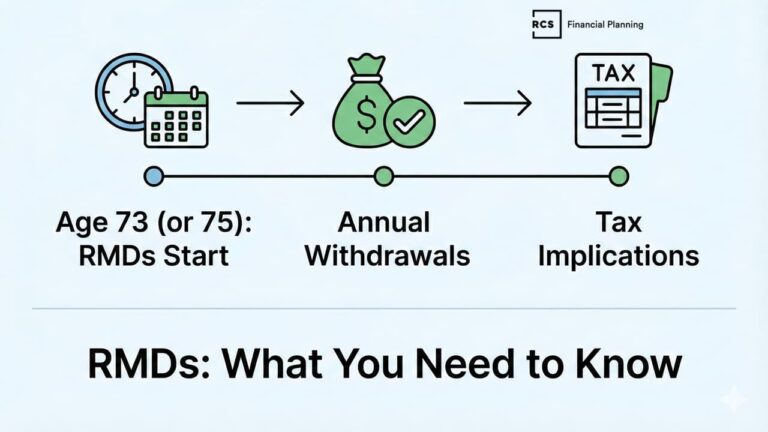
If you’re 73 or older, take your 2026 RMD by December 31. Calculate it using your IRA balances as of December 31, 2025, and the IRS life expectancy tables in Publication 590-B. If 2026 is your first RMD year, you can wait until April 1, 2027, but then you’ll take two distributions in 2027, which stacks income into one year and can push you over a threshold. For many people, taking the first RMD in 2026 is the better trade.
- Still working at 73? You can generally delay RMDs from your current employer’s 401(k) until you retire, unless you own more than 5% of the company. IRAs and old employer plans still require distributions.
- Inherited IRAs follow different rules, including a 10-year payout window for many non-spouse beneficiaries, with possible annual minimum distribution requirements.
- Missed an RMD? The penalty is 25% of the shortfall, reduced to 10% if corrected promptly.
Is a qualified charitable distribution better than writing a check?
For IRA owners 70½ or older who give to charity, a qualified charitable distribution (QCD) is usually the most tax-efficient option. The money goes directly from your IRA to the charity, counts toward your RMD, and never shows up in your AGI. You can give up to $111,000 this way in 2026. Because the gift never enters income, it also helps you stay under the IRMAA and senior deduction thresholds, and it works whether or not you itemize.
A qualified charitable distribution is a direct transfer from a traditional IRA to an eligible charity, made by an IRA owner age 70½ or older.
A few details trip people up:
- Order matters. The first dollars you withdraw from your IRA each year count toward the RMD. If you’ve already withdrawn your full RMD, a later QCD can’t make that withdrawal tax-free.
- Donor-advised funds don’t qualify. QCDs must go to an operating charity, not a donor-advised fund or private foundation.
- Allow time. Custodians need processing time, and the distribution must leave the IRA by December 31. Request QCDs by early December.
Should you do a Roth conversion in 2026?
A Roth conversion makes sense when the tax you pay now is likely lower than the tax you or your heirs would pay on the same dollars later. That’s often true in the years between retirement and the start of RMDs or Social Security. To count for 2026, you must complete the conversion by December 31, and you can’t undo it. Rather than converting to the top of a tax bracket by reflex, size the conversion against the thresholds in the table above, since IRMAA, the senior deduction, and the 3.8% surtax can each raise the true cost.
Planning points to raise with your advisor or tax professional:
- Convert in pieces. Spreading conversions across several years keeps each year’s income in a lower range.
- Pay the tax from outside the IRA if you can. Paying it from the converted amount shrinks what grows tax-free, and under 59½ it may trigger a penalty.
- Know the five-year rules. Each conversion has its own five-year clock for penalty-free withdrawal of converted amounts if you’re under 59½.
- Think about heirs. Non-spouse beneficiaries generally must empty an inherited IRA within 10 years, often during their own peak earning years. Roth dollars pass to them without income tax.
How can you lower taxes on your investments before year-end?
Taxable investment accounts offer several year-end levers: realizing losses to offset gains, realizing gains while you’re in the 0% capital gains bracket, and avoiding surprise fund distributions. Each one changes your AGI, so it belongs in the same projection as your RMD, QCD, and conversion decisions rather than in a separate December scramble.
How does tax-loss harvesting work?
Selling an investment that has fallen below what you paid creates a capital loss. Losses offset capital gains first, then up to $3,000 of other income, and any excess carries forward to future years. If you already have carryforward losses, it may make sense to realize some gains this year and use them.
Watch the wash-sale rule, which disallows the loss if you buy a substantially identical security within 30 days before or after the sale. It applies across your household’s accounts, so it can catch you when:
- a dividend reinvests into the same fund within 30 days of the sale,
- you buy the same holding in your IRA after selling it at a loss in your taxable account, or
- your spouse buys the same security within the 61-day window.
In most cases, a disallowed loss isn’t lost permanently; it’s added to the cost basis of the replacement shares. The IRA purchase is the exception, where the loss is generally gone for good.
Can you pay 0% tax on capital gains?
Yes, if your taxable income (after deductions) stays under $49,450 for single filers or $98,900 for joint filers. Long-term gains and qualified dividends that fit under that line are taxed at 0% federally. Retirees in a low-income year can sometimes realize gains, pay no federal tax, and buy the same holding back immediately to reset their cost basis. The wash-sale rule doesn’t apply to gains. Remember that those gains still raise your AGI, which can affect IRMAA and the senior deduction, and Maryland taxes capital gains as ordinary income.
What about year-end fund distributions?
Mutual funds must pass realized gains to shareholders, usually in November or December, even if you didn’t sell anything. High-turnover funds tend to distribute more. Before buying a fund in a taxable account late in the year, check whether a distribution is coming so you don’t buy a tax bill along with the shares. ETFs generally distribute fewer capital gains because of their structure.
How do you limit the 3.8% net investment income tax?
The 3.8% surtax applies to the smaller of your net investment income or the amount your MAGI exceeds $200,000 (single) or $250,000 (joint). Those thresholds aren’t indexed for inflation. IRA distributions and Roth conversions aren’t investment income themselves, but they raise MAGI and can push your dividends and gains into a higher tax bracket. Municipal bond interest is excluded, and an installment sale can spread a large gain over several years.
Should you itemize or take the standard deduction in 2026?
Compare your expected itemized deductions with the standard deduction for both 2026 and 2027, then concentrate deductions in whichever year they do the most good. The larger SALT cap means more households itemize than before 2025, but many retirees with paid-off homes still come out ahead with the standard deduction. If you’re near the line, “bunching” (itemizing in one year and taking the standard deduction in the other) can add thousands in deductions over two years.
| 2026 standard deduction | Single | Married filing jointly |
|---|---|---|
| Base amount | $16,100 | $32,200 |
| Additional amount, age 65 or older | $2,050 | $1,650 per spouse |
| Senior deduction (2025 to 2028, subject to phase-out) | up to $6,000 | up to $6,000 per spouse |
The senior deduction is available whether you itemize or not, so it doesn’t factor into the itemize-or-not decision.
Ways to shift itemized deductions between years:
- State and local taxes (SALT). The cap is $40,400 for 2026, reduced for MAGI above $505,000. Property tax payment timing can move deductions between years.
- Mortgage interest. Paying your January 2027 mortgage payment by December 31 puts that interest on your 2026 return.
- Medical expenses. Costs above 7.5% of AGI are deductible. If you’re near that line, scheduling procedures, dental work, or hearing aids before year-end can help.
- Charitable gifts. Bunching several years of giving into 2026, often through a donor-advised fund, can push you over the standard deduction in that year.
What changed for charitable deductions in 2026?
Three changes take effect this year:
- A 0.5% floor for itemizers. Charitable deductions count only to the extent they exceed 0.5% of AGI. On $200,000 of AGI, the first $1,000 of giving produces no deduction.
- A new deduction for non-itemizers. If you take the standard deduction, you can also deduct up to $1,000 ($2,000 joint) of cash gifts to qualifying charities. Gifts to donor-advised funds don’t qualify.
- A limit for the top bracket. Filers in the 37% bracket have the value of their itemized deductions reduced, so a deduction is effectively worth about 35 cents per dollar.
For those who itemize, giving appreciated investments held more than a year is often better than giving cash. You deduct the full market value and never pay tax on the gain. And for IRA owners 70½ and older, QCDs sidestep the 0.5% floor entirely because the gift never enters income.
How does Maryland change the year-end picture?
Maryland’s 2025 budget law added two provisions that matter at year-end for higher-income households: a 2% surtax on net capital gains when federal AGI exceeds $350,000, and a phase-out of Maryland itemized deductions above $200,000 of federal AGI. Because the surtax applies to all of your net gains once you cross the line, a single large sale near $350,000 can cost far more than 2% of the extra income. Maryland residents should check state thresholds alongside federal ones before realizing gains or converting.
- Capital gains surtax. Applies to net capital gains for households with federal AGI over $350,000. Gains inside retirement accounts are excluded, as is the sale of a primary residence under $1 million.
- Itemized deduction phase-out. Maryland itemized deductions are reduced by 7.5% of federal AGI above $200,000 ($100,000 married filing separately).
- Standard deduction. Maryland’s standard deduction is a flat $3,350 for single filers or $ 6,700 for joint filers.
- Retirement income. Maryland doesn’t tax Social Security benefits, and eligible retirees 65 and older may exclude part of their pension and workplace retirement plan income through the pension exclusion.
How do you avoid an underpayment penalty?
You avoid the federal penalty if withholding and estimated payments cover at least 90% of your 2026 tax or 100% of your 2025 tax, rising to 110% if your 2025 AGI exceeded $150,000. If you’re short, increase withholding before year-end instead of making a late estimated payment.
Retirees have an advantage here. Tax withheld from an IRA distribution is treated as though it was paid evenly throughout the year, even if it’s withheld in December. Many retirees take their RMD late in the year and have a large share withheld, which can cover a shortfall from earlier quarters. A December Roth conversion or a large capital gain is a good reason to recheck this before year-end.
What year-end gifts make sense for family?
You can give up to $19,000 per recipient in 2026 without filing a gift tax return or using any of your $15 million lifetime exemption. Married couples can give $38,000 per recipient by splitting gifts. Payments made directly to a college for tuition, or directly to a medical provider, don’t count against the annual exclusion at all. Recipients don’t pay income tax on gifts.
- Superfund a 529 plan. You can contribute up to $95,000 per beneficiary in 2026 and elect to treat it as five years of $19,000 gifts. 529 plans now cover K-12 tuition, graduate school, and credentialing programs as well as college. Maryland offers a $2,500 state income tax deduction per beneficiary, per taxpayer, for contributions to Maryland 529 plans. Excess contributions may be carried forward and deducted in future years.
- Consider a Trump account for a child or grandchild. These new accounts, available starting in 2026, let family members contribute for children under 18. Treat them as long-term money.
- Mind the check timing. For a personal check to count as a 2026 gift, the recipient must deposit it in 2026. A cashier’s check counts when the recipient receives it. Charitable gifts follow different rules: a check mailed by December 31 counts for 2026, as does a credit card charge made by then.
- Maryland estate tax. Maryland has its own estate tax with an exemption far below the federal amount. Coordinate large gifts with your estate attorney.
If you’re still working, what should you max out?
Pre-retirees still earning a paycheck should consider maximizing workplace plan contributions by December 31. You can make IRA contributions for 2026 until April 15, 2027.
| 2026 contribution limit | Amount |
|---|---|
| 401(k), 403(b), TSP employee contribution | $24,500 |
| Catch-up, age 50 or older | $8,000 |
| Catch-up, ages 60 to 63 (instead of the standard catch-up) | $11,250 |
| IRA contribution | $7,500 |
| IRA catch-up, age 50 or older | $1,100 |
Starting in 2026, workers who earned more than $150,000 in FICA wages the prior year must make catch-up contributions as Roth contributions.
What are the most common year-end tax mistakes?
Most costly year-end errors come from treating moves in isolation. The usual culprits are converting or selling without checking the IRMAA and senior deduction thresholds, taking an RMD before a planned QCD, and triggering a wash sale through an IRA or a spouse’s account.
- Deferring a first RMD to April without noticing it doubles 2027 income
- Waiting until late December to request a QCD or conversion, then missing the custodian’s cutoff
- Assuming a gain taxed at 0% federally has no other effects on AGI, IRMAA, or Maryland tax
- Overlooking beneficiary designations on IRAs, 401(k)s, and annuities after a marriage, divorce, or death in the family
What should you do next?
Start with a projection of your 2026 income, then work through the moves below in order. The order matters because each step changes the numbers for the next.
- Project 2026 and 2027 income. Estimate AGI, MAGI, and taxable income for both years.
- Find your nearest threshold. Note how much room you have before the next IRMAA tier, the senior deduction phase-out, or a Maryland line.
- Settle RMDs and QCDs. Request QCDs first, then take any remaining RMD. Aim to submit requests by early December.
- Size any Roth conversion to the room you found in step 2, and complete it by December 31.
- Review realized gains and losses and estimated fund distributions in taxable accounts.
- Decide whether to bunch deductions into 2026 or 2027, and make charitable gifts accordingly.
- Check withholding against the safe harbor and adjust December IRA withholding if needed.
- Make annual gifts and 529 contributions, then review beneficiary designations.
Want a second set of eyes on your year-end numbers?
Year-end planning goes better with a projection than with a checklist alone. If you’d like help seeing how these decisions fit together for your household, a discovery meeting is a simple place to start. It’s 45 minutes, there’s no cost or obligation, and you’ll leave with a clearer sense of where your income is coming from in 2026 and 2027 and how it’s being taxed.
FAQ
Ready for clarity and confidence in your retirement plan?
This material is provided for educational, general information, and illustration purposes only. You should always consult a financial, tax, or legal professional familiar with your unique circumstances before making any financial decisions. Nothing contained in the material constitutes tax advice, a recommendation for the purchase or sale of any security, or investment advisory services. This content is published by an SEC-registered investment adviser (RIA) and is intended to comply with Rule 206(4)-1 under the Investment Advisers Act of 1940. No statement in this article should be construed as an offer to buy or sell any security or digital asset. Past performance is not indicative of future results.