The New $6,000 Enhanced Senior Deduction: What Retirees Need to Know for 2025-2028
The enhanced senior deduction is a $6,000 per-person federal tax deduction for taxpayers age 65+ in tax years 2025 through 2028, with a $12,000 maximum on a joint return.
The enhanced senior deduction is a $6,000 per-person federal tax deduction for taxpayers age 65+ in tax years 2025 through 2028, with a $12,000 maximum on a joint return. If you are 65 or older, there is a new federal tax deduction worth paying attention to. The enhanced senior deduction is a temporary $6,000 per-person deduction available for tax years 2025 through 2028. On a joint return where both spouses qualify, that doubles to $12,000. It is available whether you itemize or take the standard deduction, and it sits on top of the existing age-65 additional standard deduction that retirees already get.
But the headline number is not the whole story. The deduction phases out as income climbs, and it disappears entirely at modest income levels by retirement standards. For Maryland retirees who are managing Roth conversions, capital gains realization, or large RMDs, the phaseout creates a planning consideration that is easy to miss and costly to ignore.
This article walks through who qualifies, how the math works, how it interacts with the rest of your return, and the planning moves worth thinking through before year-end.
Key Takeaways
- The enhanced senior deduction is $6,000 per qualifying taxpayer age 65+, available for tax years 2025-2028 only.
- It is available whether you itemize or take the standard deduction, and it is separate from the existing age-65 additional standard deduction.
- The deduction phases out at 6% of MAGI above $75,000 (single) or $150,000 (joint), and is fully gone at $175,000 single, $250,000 joint with one qualifying spouse, or $350,000 joint with two qualifying spouses.
- Married taxpayers must file jointly to claim it, and each qualifying individual must have a valid Social Security number.
- For 2025, the deduction is claimed on the new Schedule 1-A (Form 1040), with the total flowing to Form 1040, line 13b.
Who qualifies for the enhanced senior deduction?
You generally qualify in any year from 2025 through 2028 if you are age 65 by the last day of the tax year, have a valid Social Security number, and — if married — file a joint return. For the 2025 tax year specifically, IRS guidance defines a qualifying senior as someone born before January 2, 1961.
A few clarifying points:
- Both spouses can qualify. If both you and your spouse are 65 or older, the household can deduct up to $12,000, subject to the joint phaseout.
- One qualifying spouse still gets the deduction. If only one of you is 65+, you can still claim a single $6,000 deduction on the joint return.
- Married filing separately does not work. The statute requires a joint return for married couples.
- It is not means-tested in the same way as some credits, but the MAGI phaseout effectively limits the benefit for higher-income retirees.
How much is the deduction, and how does the phaseout work?
The deduction starts at $6,000 per eligible senior and is reduced by 6% of every dollar of MAGI above the applicable threshold. It cannot go below zero. In formula form:
- One qualifying individual: $6,000 − 6% × (MAGI − $75,000)
- Joint return with two qualifying spouses: $12,000 − 6% × (MAGI − $150,000)
Because the reduction is 6% of excess MAGI, the deduction is fully phased out once you exceed the threshold by $100,000 (for a $6,000 starting amount) or $200,000 (for a $12,000 starting amount).
Full phaseout table
| Filing scenario | Starting deduction | Phaseout begins at MAGI | Fully phased out at MAGI |
|---|---|---|---|
| 1 qualifying individual | $6,000 | $75,000 | $175,000 |
| Joint, 1 qualifying spouse | $6,000 | $150,000 | $250,000 |
| Joint, 2 qualifying spouses | $12,000 | $150,000 | $350,000 |
Two quick examples
Example 1 — Single filer, age 68, MAGI of $95,000. Excess MAGI: $95,000 − $75,000 = $20,000. Reduction: 6% × $20,000 = $1,200. Deduction: $6,000 − $1,200 = $4,800.
Example 2 — Married filing jointly, both spouses 70, MAGI of $200,000. Excess MAGI: $200,000 − $150,000 = $50,000. Reduction: 6% × $50,000 = $3,000. Deduction: $12,000 − $3,000 = $9,000.
Enhanced Senior Deduction Calculator
Estimate your federal enhanced senior deduction for tax years 2025–2028.
Enter your income to see your estimated deduction.
This calculator provides an estimate for educational purposes only and is based on the enhanced senior deduction as enacted for tax years 2025–2028. It is not tax advice. Your actual deduction may vary based on the final IRS instructions, your specific circumstances, and any subsequent legislative or regulatory changes. Consult a qualified tax professional before making decisions based on this estimate.
What counts as MAGI here?
For this deduction, MAGI is your adjusted gross income, increased by any amounts excluded under IRC §§ 911, 931, or 933 (foreign earned income and certain U.S. territory income). For most domestic retirees, MAGI for this purpose will simply equal AGI. That is a different MAGI definition than the one used for IRMAA, ACA premium credits, or Roth IRA contribution limits, so do not assume the numbers carry over.
How does this interact with the standard deduction and other senior tax breaks?
The enhanced senior deduction is separate from, and stacks with, the existing age-65 additional standard deduction. Eligible seniors get the regular age-65 standard deduction increase plus the new $6,000 enhanced senior deduction. It is also available to taxpayers who itemize, which is unusual — most age-based tax benefits in the past have been baked into the standard deduction itself.
For reference, the 2026 standard deduction amounts are:
- Single or married filing separately: $16,100
- Married filing jointly: $32,200
- Head of household: $24,150
- Over 65: Additional $2,050 for single filers and $1,650 for joint filers
A 70-year-old single filer who takes the standard deduction in 2025 could combine the regular standard deduction, the existing age-65 additional standard deduction, and the new $6,000 enhanced senior deduction — assuming MAGI is at or below $75,000.
The Essential Retirement Readiness Checkup
See how seven critical retirement decisions interact to shape your income, taxes, and long-term security — often in ways most people don’t see until it’s too late. Get clarity on how your retirement decisions work together — not just on paper, but in real life.
Where do you claim it on the return?
For 2025 returns, the IRS has created a new form. Eligible seniors will claim the enhanced senior deduction on Schedule 1-A (Form 1040), Additional Deductions, and the total from that schedule flows to Form 1040, line 13b. If you use a tax preparer or tax software, this should be handled automatically once your date of birth and income are entered, but it is worth confirming the deduction actually appears on the return rather than assuming it did.
What planning issues should retirees think through?
The deduction is straightforward to claim, but it creates several planning considerations that are easy to overlook.
The deduction is straightforward to claim, but the MAGI phaseout creates planning considerations — Roth conversions, capital gains harvesting, and RMD timing — that are easy to overlook.
1. Roth conversions and the phaseout cliff
A Roth conversion increases AGI in the year of the conversion. For a couple in their late 60s with $140,000 of AGI considering a $50,000 conversion, the conversion itself moves them from the full $12,000 deduction down to $9,600 — a real, if modest, additional cost on top of the federal tax owed on the conversion. That doesn’t necessarily kill the conversion case, but it should be modeled, especially alongside IRMAA, ACA, and capital gains bracket effects.
Roth conversion that pushes a couple from $140,000 to $190,000 of MAGI quietly costs them part of this deduction — a real planning cost worth modeling alongside the conversion itself.
2. The window is temporary
The deduction applies only to tax years 2025 through 2028. Whether Congress extends it is unknowable. If you are in your early 60s and planning a multi-year tax strategy, treat this benefit as a feature of the next four tax years rather than a permanent fixture of retirement.
Treat the enhanced senior deduction as a feature of the next four tax years, not a permanent fixture of retirement. The window closes after 2028 unless Congress acts.
3. The phaseout interacts with RMDs
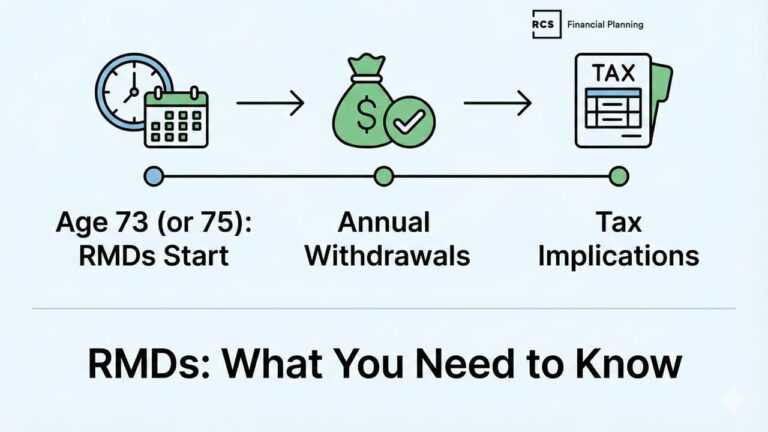
Required minimum distributions begin at age 73. For retirees with substantial pre-tax IRA balances, RMDs alone can push MAGI past $75,000 single or $150,000 joint, eroding the deduction over time. Some clients may want to accelerate distributions or convert in lower-income years before RMDs begin to preserve more of the deduction in later years.
4. Watch the interaction with capital gains harvesting
For retirees who try to harvest long-term capital gains in the 0% bracket, every dollar of additional capital gain raises AGI and therefore MAGI. A tax-free gain harvest at the federal level can still cost you part of this deduction.
5. Maryland retirees: don’t confuse this with state benefits
This is a federal deduction. Maryland has its own pension exclusion and senior tax credit, and those rules are unchanged by this federal provision. Effective retirement tax planning in Maryland still requires looking at both layers.
What should you do next?
A short checklist for the next time you sit down with your tax planner or financial advisor:
- Confirm eligibility. Will you (or your spouse) be 65 by year-end?
- Estimate your MAGI for 2025 and project it for 2026-2028.
- Identify any income-shifting levers — Roth conversions, capital gains realization, deferred income — and model how they push you up or down the phaseout.
- Coordinate with IRMAA and ACA planning. Each uses a different MAGI definition, but they tend to move together.
- Verify the deduction shows up on your filed return — on Schedule 1-A and line 13b of Form 1040 for 2025.
If you want a second set of eyes on how this deduction fits into your broader retirement income plan — Roth conversions, RMDs, IRMAA, and Maryland-specific tax planning — we are happy to have a conversation. There is no obligation, just a conversation about whether your current plan is taking full advantage of the rules in front of you.
Enhanced Senior Deduction FAQ
Ready for clarity and confidence in your retirement plan?
This material is provided for educational, general information, and illustration purposes only. You should always consult a financial, tax, or legal professional familiar with your unique circumstances before making any financial decisions. Nothing contained in the material constitutes tax advice, a recommendation for the purchase or sale of any security, or investment advisory services. This content is published by an SEC-registered investment adviser (RIA) and is intended to comply with Rule 206(4)-1 under the Investment Advisers Act of 1940. No statement in this article should be construed as an offer to buy or sell any security or digital asset. Past performance is not indicative of future results.